A little more to explore…
Client project / Performance optimization / Technical SEO / Lead workflows
Charette Cosmetics.
Performance optimization, technical SEO cleanup and lead-capture validation for an existing WordPress / Elementor website, preserving its design, booking and shopping journeys. Delivered within a Xovotech engagement; mobile optimization remained under iterative review at the latest documented checkpoint.
Project URL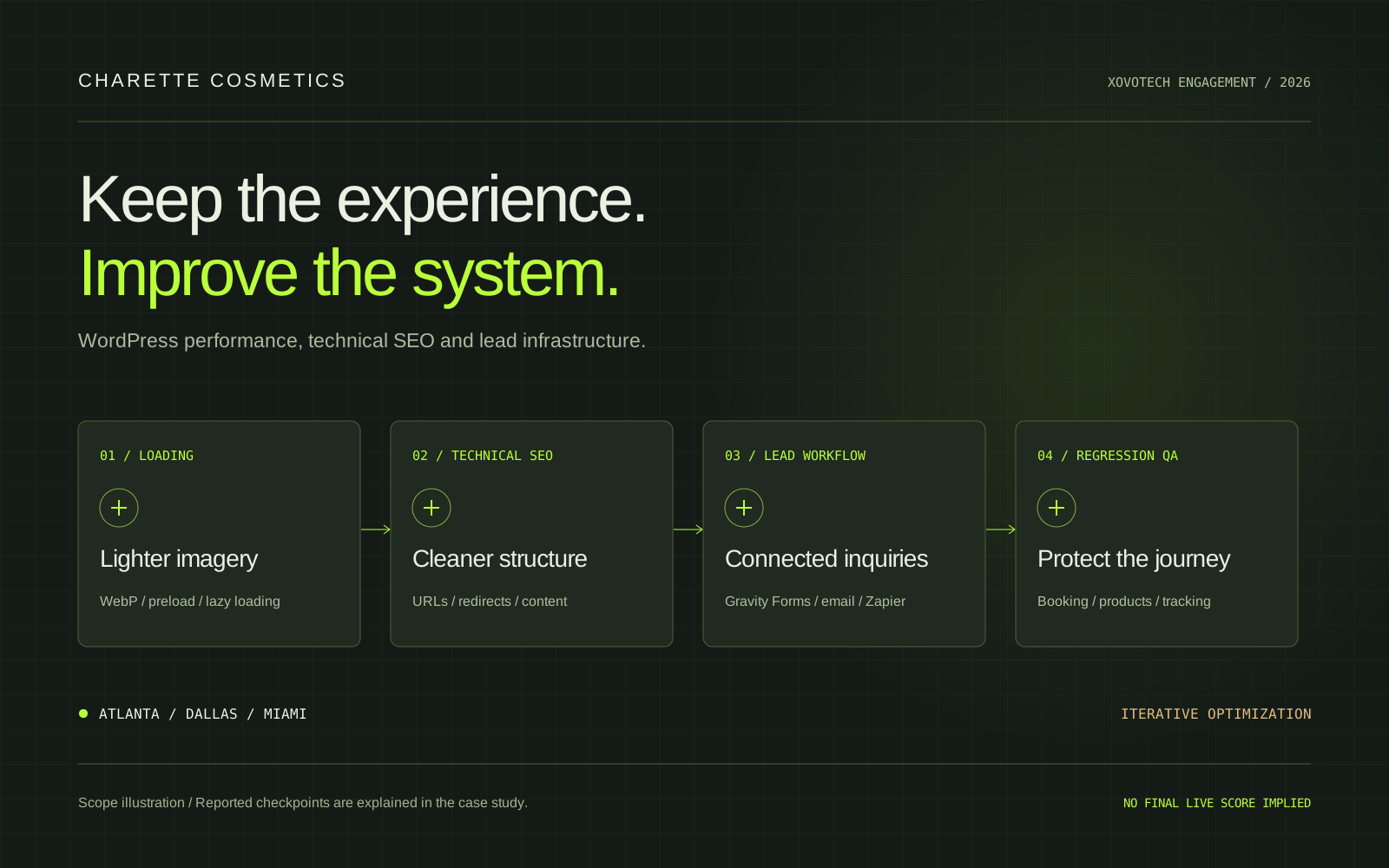
The implementation map
EXPLORE EACH PART OF THE SYSTEM
01 / SYSTEM COMPONENT
Loading experience
Key homepage imagery was optimized, including an oversized hero PNG converted to WebP. Preload behavior, below-the-fold lazy loading and third-party loading were reviewed while retaining interactive features.
ARCHITECTURE OVERVIEW / THIS PORTFOLIO DOES NOT RUN THE CLIENT’S PRIVATE SYSTEM.
01 / THE IMPLEMENTATION
The problem and context
Charette Cosmetics is a medical aesthetics brand serving Atlanta, Dallas and Miami, with treatment information, booking calls to action, skincare products and third-party integrations on an existing WordPress / Elementor website. Following a move from SiteGround to WordPress.com Business, the engagement addressed loading performance, technical health and lead-capture reliability while preserving the established visual identity. An early reported PageSpeed snapshot recorded mobile 31/100 and desktop 41/100, with mobile Largest Contentful Paint around 19 seconds. A roughly 1.24 MB PNG hero image was among the loading concerns. Duplicate and legacy URLs, incorrect destinations and form-handling dependencies also needed attention.
02 / THE IMPLEMENTATION
What this demonstrates
The objective was a more reliable website with less avoidable loading overhead and clearer technical structure. Changes needed to retain customer-facing behavior: treatment discovery, appointment booking, shopping, tracking and security features. The engagement therefore treated speed, SEO hygiene and lead handling as connected responsibilities. It did not pursue a score by disabling important functionality, and the supplied record does not establish conversion or revenue improvements.
03 / THE IMPLEMENTATION
The decisions
Homepage image work included converting the oversized hero PNG to a more efficient WebP asset and introducing appropriate preload behavior. Additional assets, including Image-2-1.webp, were reduced, with lazy loading considered for content below the fold. Caching, script execution and deferred third-party content were reviewed, including interactions among LiteSpeed/Cloudflare-related settings. Aggressive combine, defer and delay options remained disabled where they posed compatibility risks. Late loading for embedded maps was evaluated alongside the effect of changes on LCP and interactive behavior.
04 / THE IMPLEMENTATION
Content and data
Technical SEO work addressed URL consistency as well as the content visitors reached. Trailing-slash behavior and internal destinations were standardized; duplicate, obsolete and test pages were audited, with removal, noindex treatment or relevant redirects where appropriate. Homepage and navigation links, incorrect or missing content and 404 destinations were reviewed. Text accuracy, logo alternative text and heading/link hygiene formed part of the cleanup. These activities are described as technical and editorial corrections, without a claim of a measured increase in search rankings.
05 / THE IMPLEMENTATION
Implementation
The lead-capture work covered form submission, confirmation handling and the systems that receive an inquiry. The supplied engagement record describes working form handling, Gravity Forms submission checks and validation of a downstream Zapier webhook. SMTP/email delivery and integration dependencies were tested after the hosting transition. Microsoft 365 email continuity was an important consideration during the move to WordPress.com Business. The purpose was to reduce the risk of a form appearing successful while the inquiry failed later in the workflow; no numerical reduction in missed leads is asserted.
06 / THE IMPLEMENTATION
Validation approach
Mobile and desktop PageSpeed tests were repeated during optimization, with particular attention to mobile LCP and possible desktop regressions. Audit or bot-protection restrictions and timeout behavior were investigated where they affected testing. Responsive layouts, visible copy, accessibility details and live user paths were checked after changes. Booking, product flows, tracking and security functions remained important regression areas. A dated technical checkpoint archive supported rollback. This portfolio summarizes those reported checks and does not certify the current state of the live website.
07 / THE IMPLEMENTATION
The result
The supplied record reports an early baseline of mobile 31/100 and desktop 41/100. An improved checkpoint was approximately mobile 55–58/100 and desktop 74/100. Additional separate test snapshots reached mobile 74/100 and desktop 91/100; the source explicitly says those peaks were not consistently sustained together. These are documented checkpoints during iterative work, not a verified final live score or a controlled before/after result. The delivered work combined lighter homepage assets, technical SEO corrections and validation of forms and connected services, while mobile performance remained a follow-up focus.
08 / THE IMPLEMENTATION
Evidence and limitations
PageSpeed measurements can vary with test conditions, caching, server response and page revisions. The figures in this case are attributed to the user-supplied Xovotech engagement document, rather than newly measured by this portfolio. The latest known checkpoint still called for stabilizing mobile speed while preserving desktop performance and interactive features. No permanent 80+ mobile score, conversion uplift or revenue increase is claimed. The business relevance is practical: reduce unnecessary loading work, make internal navigation and indexable content more consistent, and keep the inquiry, booking and product journeys functioning during optimization.
09 / THE IMPLEMENTATION
Handover and next steps
The next phase described in the source was continued mobile optimization and resolution of remaining loading bottlenecks, with desktop performance and customer-facing functions protected during each iteration. Future review should compare agreed URLs under recorded test conditions and recheck booking, shopping, form delivery and integrations after changes. Technical checkpoints provide a rollback reference. This case study represents work reported during the 2026 engagement, with source context dated 2 November 2026; it should be updated when a final agreed benchmark or additional validated outcome becomes available.
Have a related task?
Bring the workflow.
We’ll clarify the next scope.
7StarLife
Let’s scope the next task
GOOD WORK STARTS WITH A CLEAR BRIEF.
What needs
moving forward?
A WordPress issue, a small feature or a backlog item? Start with one clear brief. Availability, scope and timing are agreed before work begins.
SCHEDULED COLLABORATION / PKT · UTC+05:00
new-inquiry.md